In an era where "five bars" of signal is as essential as electricity or running water, indoor connectivity has become a primary driver of property value. For developers and property managers, a Distributed Antenna System (DAS) is the gold standard for ensuring seamless wireless network coverage throughout a building.
Using cellular wireless networks as an example, this guide breaks down the fundamentals of DAS technology, the financial realities of implementation, and how to navigate the complex relationship between property owners and network operators.
What is a DAS?
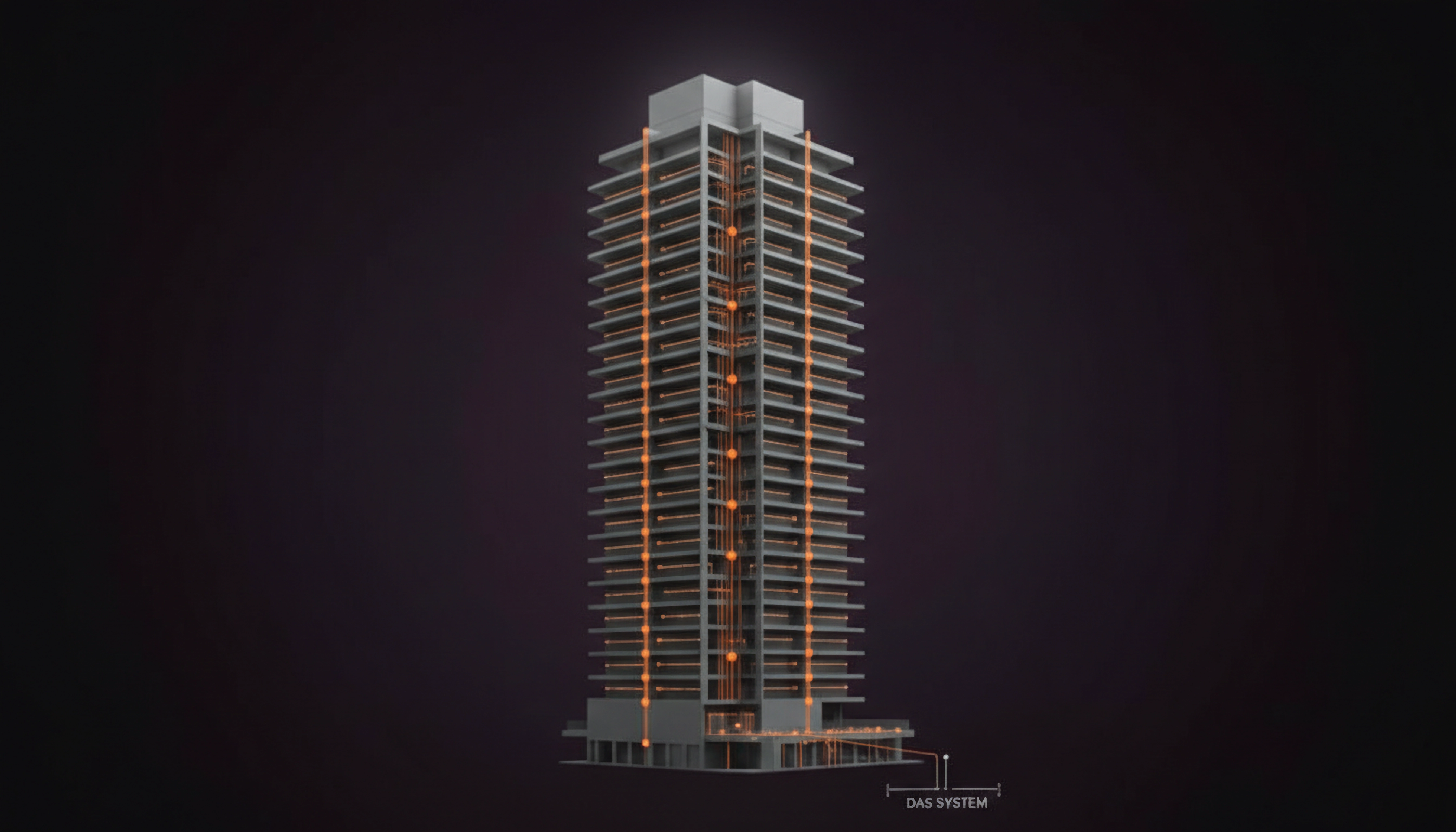
A Distributed Antenna System is a network of spatially separated antenna nodes connected to a common source via a transport medium (typically fiber optics or coaxial cable). While a traditional cell tower (macro site) tries to push signal into your building from the outside, a DAS originates the signal inside your building.
- The Headend: The "brain" of the system, usually located in a telecom room, where carrier signals are processed.
- The Distribution: A network of cables (fiber/coax) that runs through the risers and ceilings.
- The Antennas: Small, unobtrusive "nodes" placed throughout the facility to ensure no dead zones in elevators, basements, or stairwells.
The Bottom Line: Costs and Expectations
Understanding the investment is crucial for project pro formas and annual budgets. While every building has unique RF (Radio Frequency) challenges, the industry follows these general benchmarks:
| Component | Estimated Cost (per sq. ft.) | Factors Influencing Price |
|---|---|---|
| Basic Coverage | $0.75 – $1.50 | Large open spaces (warehouses, garages) |
| Standard Commercial | $2.00 – $4.00 | Multi-tenant offices, high-rise residential |
| High-Density / Complex | $5.00+ | Hospitals, stadiums, LEED-certified glass |
Major Stakeholders: Who Owns What?
The biggest shift in the DAS landscape over the last decade is who pays for the system.
- The Carriers (Bell, Rogers, Telus): Historically, carriers funded systems in high-traffic venues (stadiums/airports). Today, they rarely fund private commercial or residential builds. Their role is now primarily as the "Signal Provider," granting permission to rebroadcast their frequencies.
- The Property Owner: In the modern market, the owner is the primary stakeholder. You own the infrastructure, just like your HVAC or Wi-Fi. This gives you control over the user experience and the ability to support all carriers equally.
- The Integrator (Linkwave): Throughout the entire cycle of the project we act as the bridge: managing the technical engineering and the rigorous carrier approval process during the design phase, ensuring adherence to the design and installation standards during the deployment phase, and finally, maintaining the system as one of the carriers' requirements is for DAS to be maintained by a professional integrator.
Why Partner with Linkwave?
Navigating the intersection of construction, real estate, and telecommunications requires a Subject Matter Expert (SME) who speaks all three languages. Linkwave Wireless Solutions provides:
- Strategic Engineering: We don't just "place antennas." We use predictive modeling to ensure maximum coverage with minimum hardware, protecting your ROI.
- Carrier Relations: We handle the complex legal and technical "retransmission agreements" required to get carrier signals into your building.
- Certified Implementation: Our teams are certified in the latest hardware and safety standards, ensuring your project stays on schedule and code-compliant.
- We pair decades of experience with a commitment to Innovation, Quality and Integrity. This unique combination ensures that no matter how complex the technical hurdle, we will solve it. Partnering with us means a wireless infrastructure that is built to last, stays on schedule, and keeps your occupants connected for the long haul.
Is your property ready for the next generation of connectivity?
Let's discuss your specific square footage and coverage needs.
Contact Us