
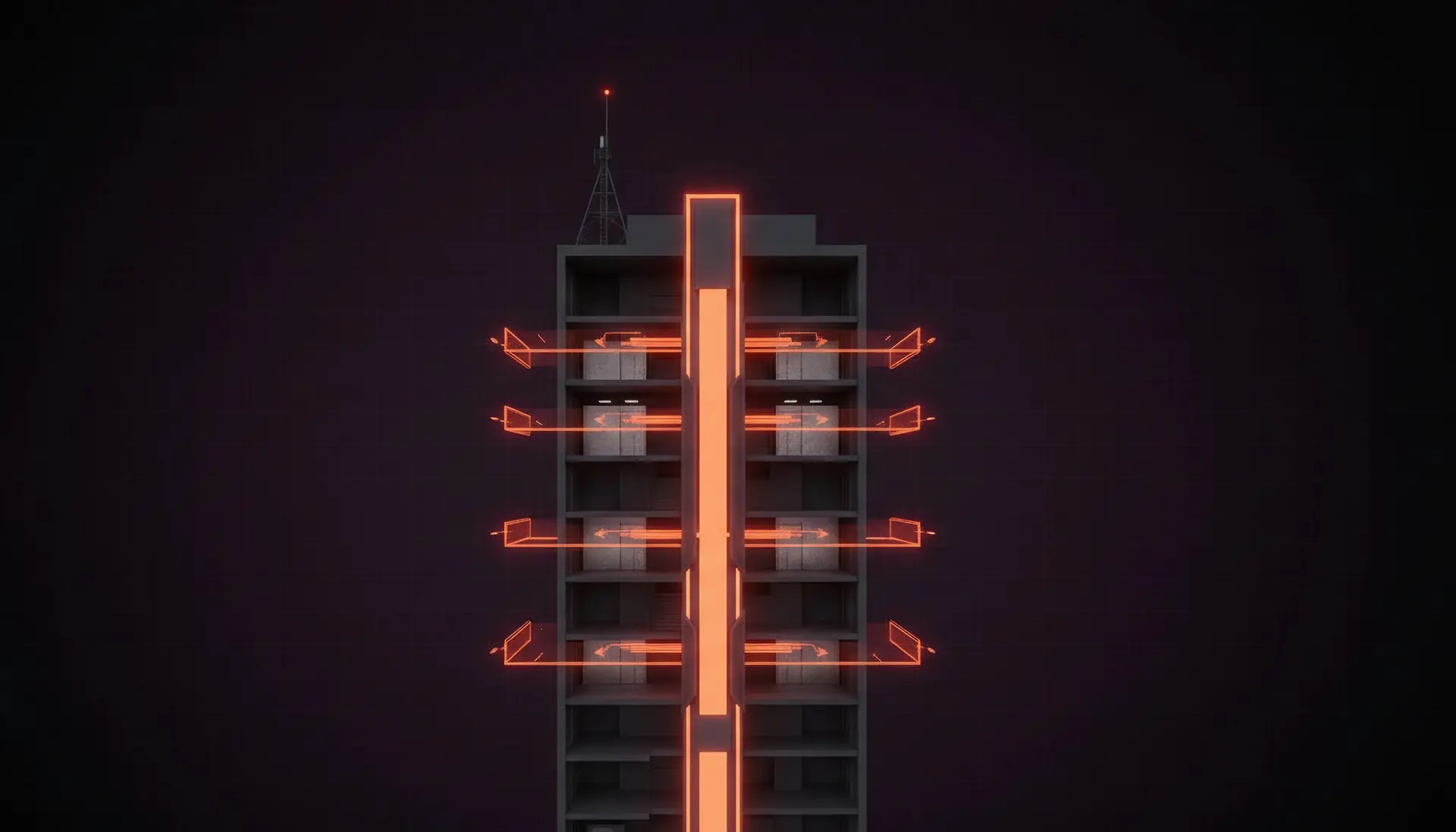
An Emergency Radio Communication Enhancement System (ERCES) makes sure firefighter, police and EMS radios work everywhere in a building, including basements, stairwells and underground levels. In the US it is required under IFC Section 510 and NFPA 1225. Canadian requirements are evolving under the NBC, NFC and ISED rules. Without one, a building can fail its fire inspection.
In an emergency, communication is the difference between chaos and a coordinated rescue. When first responders enter a building, their radios must work—regardless of concrete walls, underground levels, or energy-efficient glass that blocks signals.
What Is an ERCES and Why Does a Building Need One?
An Emergency Radio Communication Enhancement System (ERCES) is a specialized signal-boosting solution designed to ensure that public safety radio signals penetrate every corner of a structure. Without it, dead zones can trap first responders in "radio silence," putting both the building occupants and the emergency teams at risk.
Which Codes Require ERCES in the US and Canada?
Connectivity is no longer a luxury; it is a life-safety requirement. While jurisdictions across North America are at different stages of enforcement, the trend is clear: mandatory compliance is coming. Linkwave ensures your asset stays ahead of the curve, regardless of where you build.
- United States: Established Excellence — We ensure full compliance with the primary US mandates, including IFC Section 510 and NFPA 1225 (formerly NFPA 1221). From UL 2524-listed hardware to annual recertification, we navigate the rigorous requirements of local Authorities Having Jurisdiction (AHJs) to secure your Certificate of Occupancy.
- Canada: Proactive Compliance & Future-Proofing — The Canadian landscape is currently evolving toward a unified standard. Leveraging our deep history in the market, Linkwave works actively with decision-influencing authorities to stay at the forefront of these developments. We apply a "best-of-breed" strategy—combining proven US reliability with Canada-specific NBC (National Building Code) / NFC (National Fire Code) and ISED (Innovation, Science and Economic Development Canada) requirements.
- The Linkwave Advantage: Because we operate at the intersection of both markets, we don't just react to codes—we anticipate them. Partnering with us means your infrastructure is designed to solve today's problems while remaining adaptable to the regulations of tomorrow.
- The "Future-Proof" Strategy: Even if your current region does not strictly enforce these codes today, the liability and safety trends suggest they will soon. Retrofitting a building during a mandate is significantly more expensive than integrating a system during a planned upgrade or construction phase.
Why Do Buildings Fail ERCES Inspections?
In jurisdictions where public safety connectivity is mandated, a failed fire marshal inspection can halt a Certificate of Occupancy (CO), delaying your building's opening and costing thousands in lost revenue. Common pitfalls include:
- Improper Shielding: Systems that interfere with the public safety macro network.
- Lack of Monitoring: Systems that aren't tied into the building's fire alarm control panel.
- Uncertified Design: Using generic cellular boosters instead of dedicated, code-compliant Public Safety BDA (Bi-Directional Amplifier) solutions.
The Linkwave Advantage: From Blueprint to Broadcast
At Linkwave Wireless Solutions, we don't just install hardware; we provide peace of mind. As Subject Matter Experts in the RF landscape, we guide building owners through the maze of local ordinances and technical hurdles.
- Professional Consultation: We handle the initial "Grid Testing" to determine if your building actually needs a system, potentially saving you from unnecessary expenses.
- Strategic Engineering: Our team designs iBwave-certified plans that guarantee coverage while meeting all local standards.
- Certified Implementation: Linkwave Wireless technicians ensure your system is commissioned correctly, integrated with your fire panel, and ready for a "first-pass" approval.
Related services: Public Safety Radio. Case studies: Brentwood Towers, Union Station.
Is your building ready for a fire marshal inspection?
Let's ensure your public safety coverage meets code—before it's a problem.
Contact Us