
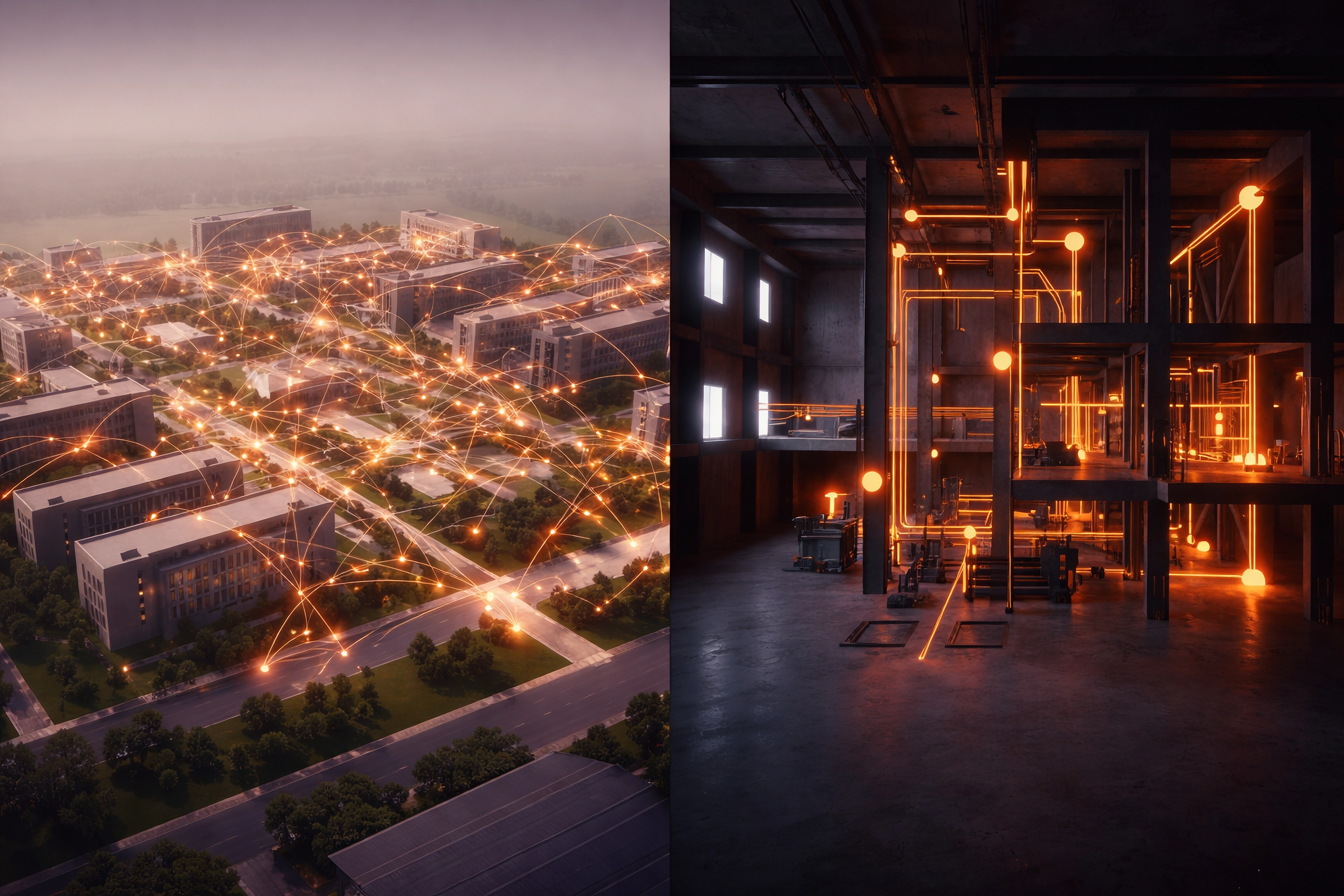
For Enterprise CIOs, Operations Directors, and Facility Leaders across industries—from sprawling healthcare networks to massive distribution centers—the "connectivity" line item has evolved from a simple service into a scalable utility. With the arrival of Wi-Fi 7 and the increasing accessibility of Private LTE/5G (CBRS in the US and NCL in Canada), many leaders feel forced to choose a winner in a "speed test" battle. At Linkwave Wireless Solutions, we believe this is a false choice.
We view Wi-Fi 7 and Private 5G not as competitors, but as two hands solving one problem: the need for ubiquitous, reliable connectivity across diverse environments.
- The First Hand (Wi-Fi 7): In high-density office environments, Wi-Fi remains the undisputed king of productivity. Its ability to utilize 320 MHz channel widths supports massive throughput for video conferencing and cloud collaboration on natively compatible devices like laptops and phones.
- The Second Hand (Private 5G): However, as we move from carpeted offices to concrete industrial spaces, Wi-Fi faces physical limitations. As seen in real-world distribution centers, Wi-Fi can suffer from spotty coverage and latency spikes up to 5x higher than Private Wireless when the network is loaded. Private 5G steps in here to offer the deterministic low latency and seamless handover capabilities that critical machines—like Autonomous Guided Vehicles (AGVs) and robotics—demand for safety and precision.
Rather than pitting these technologies against one another, a strategic engineering approach leverages the strengths of both to eliminate dead zones and future-proof your facility.
The Comparative Landscape
| Feature | Wi-Fi 7 (802.11be) | Private LTE/5G |
|---|---|---|
| Best For | High-density indoor offices, guest access, IT-managed devices. | Mission-critical IoT, outdoor-to-indoor handovers, wide-area coverage. |
| Spectrum | Unlicensed (2.4, 5, and 6 GHz). | Licensed. |
| Latency | Ultra-low (~5ms), but subject to interference. | Deterministic low latency (<10ms) with high reliability. |
| Security | WPA3 (Strong, but device-dependent). | SIM/eSIM based (Industrial grade). |
| Cost Profile | Lower CapEx; Higher OpEx in complex environments. | Higher initial CapEx; Lower TCO for large-scale coverage. |
Cost-Benefit Analysis: Environmental Fit Across the Enterprise
1. High-Density "Carpeted" Environments (Tech Parks, Corporate Offices)
In a multi-tenant tech park and corporate offices, Wi-Fi 7 is often the primary driver for indoor productivity. Its ability to utilize the 320 MHz channel width allows for massive throughput, perfect for high-definition video conferencing and cloud-based collaboration.
Familiarity and cost. Most end-user devices, like laptops and phones, are natively compatible, making it the ideal connectivity layer for the human workforce.
"Spectrum Congestion." In a dense tech park or corporate office, overlapping Wi-Fi signals can lead to packet loss. Strategic engineering is required to manage the 6 GHz band effectively.
2. Mission-Critical & "Concrete" Environments (Industrial, Logistics, & Healthcare)
For automated guided vehicles (AGVs) in warehouses, robotics on a manufacturing floor, and large-scale sensor arrays, Private LTE/5G offers a distinct advantage in secure "Handover" capability. It acts as the secure, unshakeable backbone for an enterprise's most critical operations.
Unlike Wi-Fi, where a device might "drop" for a millisecond when moving between Access Points, Private 5G manages handovers at the network level, ensuring zero-drop connectivity for moving machinery. Additionally, because it operates with a higher transmit power and lower noise floor, it provides pervasive coverage across massive indoor and outdoor footprints using a fraction of the hardware.
Higher initial infrastructure cost and the requirement for SIM-provisioned devices. However, for large-scale enterprise deployments, the total cost of ownership (TCO) is often significantly lower due to reduced hardware and installation needs.
Strategic Decision Matrix
To choose the right protocol, CIOs should evaluate their projects based on three primary metrics: Mobility Requirements, Device Density, and Security.
Why Linkwave Wireless Solutions?
Navigating the 6 GHz spectrum of Wi-Fi 7 or the regulatory landscape of CBRS and NCL for Private 5G requires more than just hardware—it requires Strategic Engineering.
At Linkwave Wireless, we don't just sell equipment; we design ecosystems. Our expertise ensures that your wireless backbone is not just fast, but future-proof.
- Professional Consultation: We analyze your site's RF environment to determine the optimal tech stack.
- Strategic Engineering: Custom-built heat maps and capacity planning to eliminate "dead zones" before they happen.
- Certified Implementation: Rigorous deployment standards that ensure your network meets the SLAs your tenants and operations demand.
Ready to architect your environment?
Let's design a converged wireless strategy that fits your enterprise today and scales for tomorrow.
Contact Us